The Discalced Carmelite Desert of
The Ecstasy of St. Teresa of Las Palmas
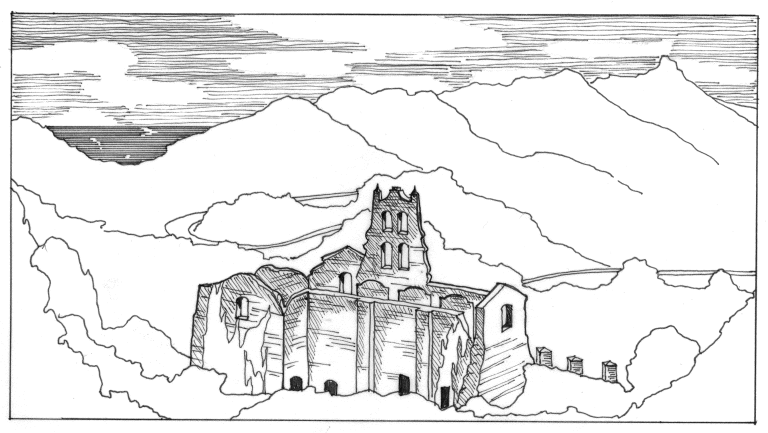
The Desert of St. Teresa of Las Palmas, near Benicassim on the outskirts of Valencia, is without a doubt the largest of the post-Teresian Deserts. It was also much later than many of the Deserts, as construction began in 1697, almost one hundred years after Las Batuecas, and thus over four hundred years after the Carmelites originally settled in Europe at Les Aygalades (France), and Aylesford (England).
A Brief History
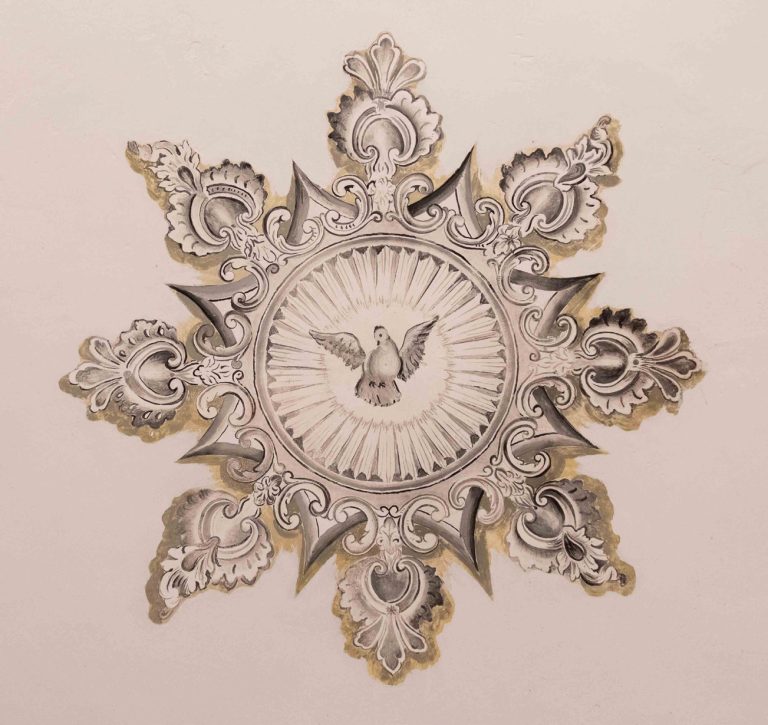
Painted Decoration at Hermitage Chapel Ceiling
Las Palmas is also unique in that its religious observance continued almost undisrupted from its founding up to the present moment. Government suppression occurred as a result of revolutions in most of the states of Europe in the modern era. Las Palmas was spared only because of an incredible love and loyalty the local towns had for Las Palmas; and this on account of the heroic and self sacrificing service of the Carmelites during an outbreak of cholera shortly before the attempted suppression, as Fr. Bruno Mary recounts in the following pages. However, there was one short period of time in which the eremitical observance was interrupted; following a sever drought, winter rains and winds created mudslides which threatened the structural integrity of the original monastery, and thus a new site was chosen nearer to the crest of the mountains, and a new monastery built there about a hundred years after the original.
“The repercussions of the political events that so often and seriously troubled Spain were felt as far as the Desert. First there was the War of Succession (1701–14), the last phases of which took place in the vicinity of Las Palmas. At different times, both the French and Austrian armies took over the monastery. The following anecdote will give an idea of the rigor with which monastic rule was observed even during the war.
A soldier traveling through the territory met a brother and asked him where the company was; the brother shrugged his shoulders to indicate that he did not know. The soldier, believing that the brother had not heard, repeated the question but received the same mute answer. Thinking he was being mocked, he stepped forward and threatened to shoot, but the brother did not intend to break the silence, even to save his life. However, before the soldier could fire his rifle “a man,” says the Chronicle, “or rather an angel, came running up to the soldier and said to him: ‘do not you know that these monks keep an inviolable silence?’” The soldier, dumb founded and terrified of the apparition, ran away as fast as he could. When he then told his comrades about his adventure, he did not fail to add that in Las Palmas, there were as many saints as there were religious.
During the summer of 1783, a dreadful drought affected the part of Spain where the Desert is located. Every morning, a thick fog covered the ground, but it dissipated during the day and all hope of rain disappeared. Every day, they prayed and made processions to get water, but in vain. Then, on September 17, such a gust of wind broke out that the earth shook to its foundations. The same thing happened almost daily until December. Rain fell in torrents; the river flowing by the monastery became a chasm where boulders capsized. The water was wearing down the walls, and in a short time it became clear that the foundations could not withstand the violence of the elements. Cracks formed, walls collapsed, and the vaults began to give way. Thirteen priests, three choir singers, three lay brothers and as many oblates were distributed among the various monasteries of the province. The Blessed Sacrament and the coffins of the dead were taken to the porter’s chapel. The eremitical observance was interrupted from January 1, 1784 until November, 1788.
The foundation stone of the new church was laid on March 5, 1791, and the church was consecrated on August 27, 1795. The ruins of the first monastery still remain and can be visited although each storm causes stones to fall, accelerating the final collapse...
Hermano, una de dos:
O callar, o hablar con Dios,
Que en el yermo de Teresa
El silencio se profesa.
Brother, do one of two:
Quiet, or speak with God
For in Teresa’s desert
Silence is professed.
“These four lines can still be read today at the front door of Las Palmas... Poetry found a fertile ground at Las Palmas. The collection of inscriptions is no less than 60 printed pages, and is quite lovely.”
Original Chapel Ruins
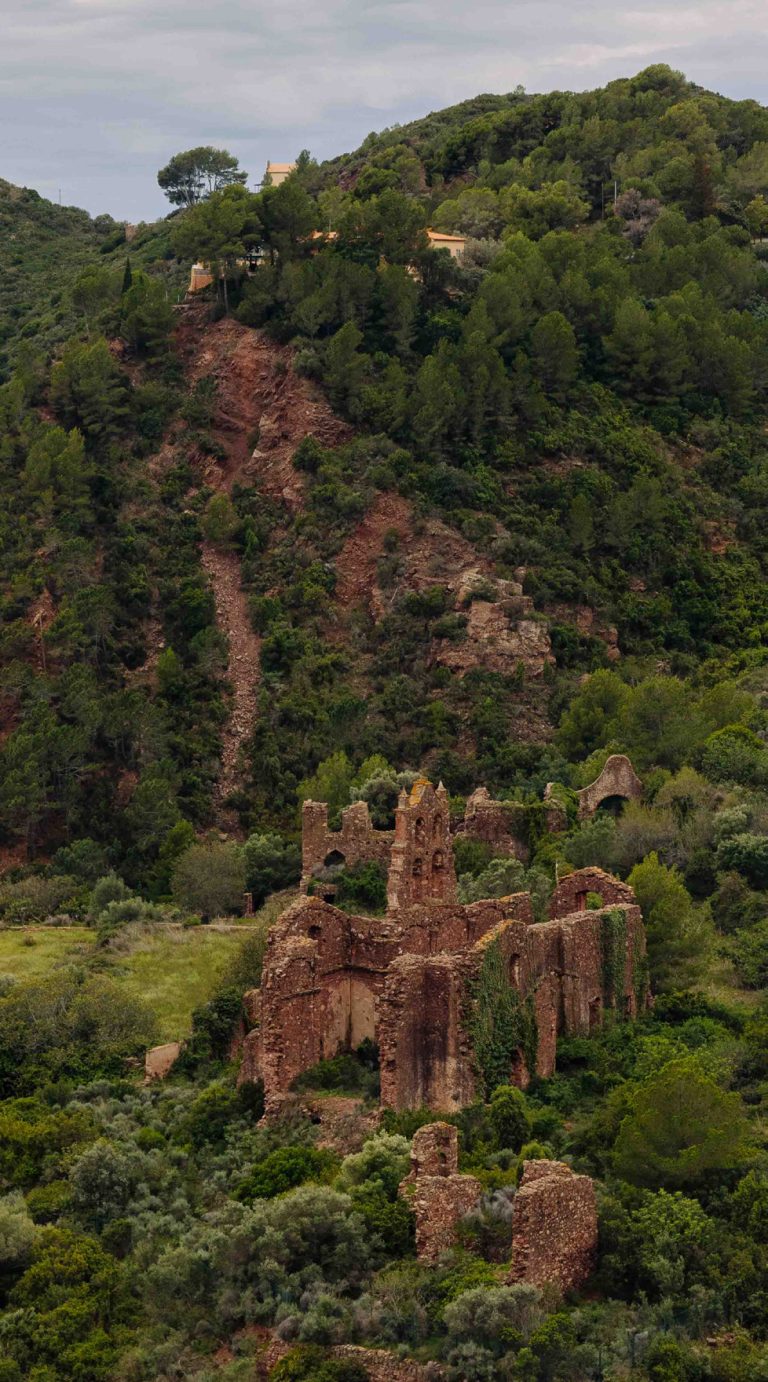
The original monastic chapel at the Desert of Las Palmas stands to this day, despite almost two hundred and fifty years of continual degradation after its abandonment.
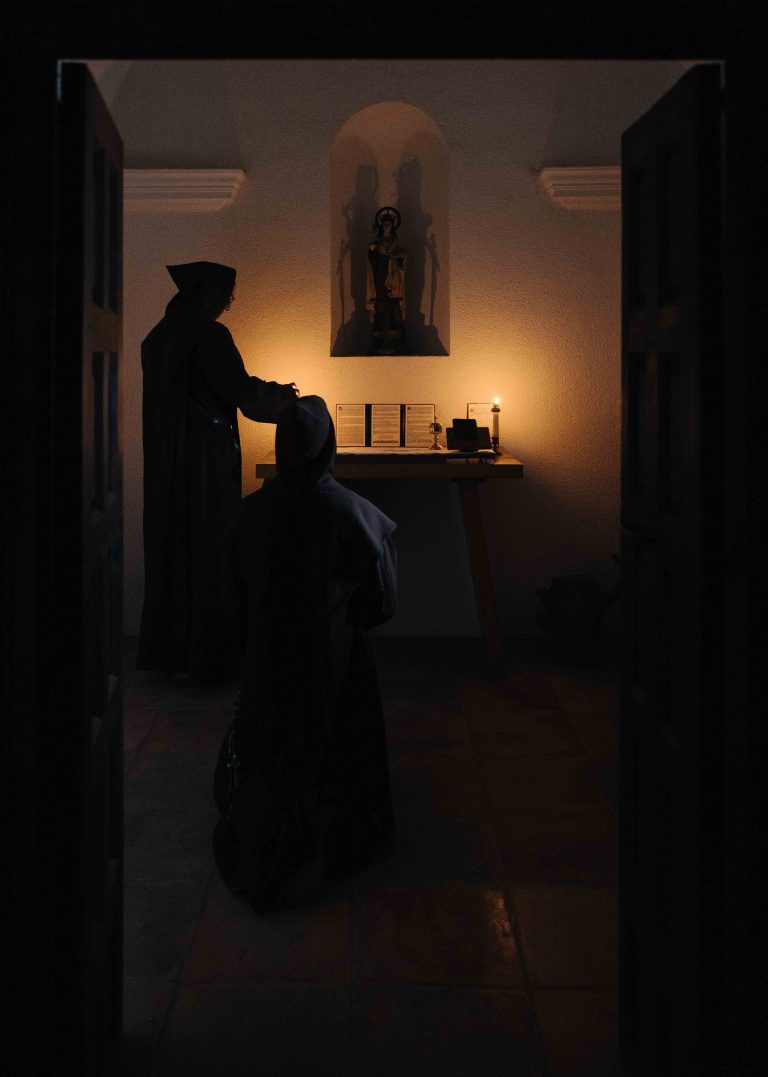
Holy Mass at St. Teresa of Jesus Hermitage
It was the great joy of the Carmelite Fathers to celebrate Holy Mass in the dwelling of their forebears, who gave their life to the eremitical observance in this simple but extraordinary place. The glow of candlelight illumines the wall, niche, plaster mouldings, and vault of the hermitage chapel, and reflects off the earthen ware tiles worn smooth by centuries of prayerful knees and footfalls.
Two years before these sad events [1822], cholera had devastated the provinces of Aragon and Valencia and our fathers had offered to treat the sick. Many had even made their supreme sacrifice at the bedside of the plague victims. Traveling from village to village and from town to town, they dedicated their entire lives to the poor and sick. Wherever they appeared, the people went out to meet them, kissing their hands respectfully because they looked like angels descended to Earth. Day and night they were found near the sick and dying. Their fields of action were hospitals and prisons, as well as the huts of the poor.
It is not surprising that the inhabitants of both provinces were more upset by the imminent suppression of the Desert than the religious themselves! The mayor of Castellón approached the government to ask that Las Palmas be spared as a token of gratitude for all that the religious had done during the time of cholera and his tireless efforts were successful.”
From The Holy Deserts of the Discalced Carmelites by Friar Bruno Mary of the Holy Cross, O.C.D. (Benedict Zimmerman)
Architecture
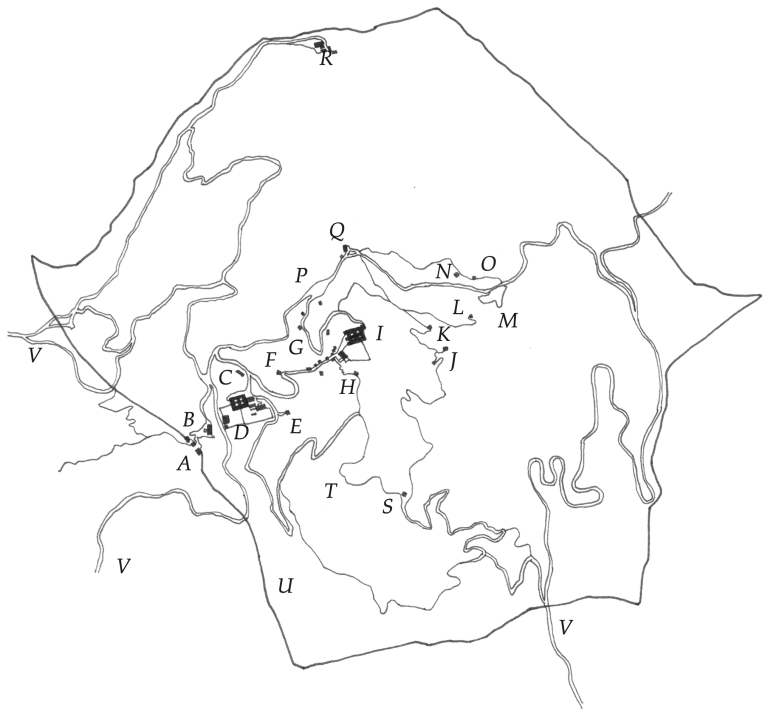
Desert Plan
Las Palmas is one of the largest of all the historic Carmelite Deserts, encompassing approximately 850 acres within its outer wall.It is also extremely topographical, rising over 1900 feet from the valleys in the Southeast to the St. Michael Hermitage at the mountain peak. For the most part, the climate is warm and gentle, tempered by the Mediterranean sea, though the altitude of its mountain slopes can expose the Desert to more severe conditions.
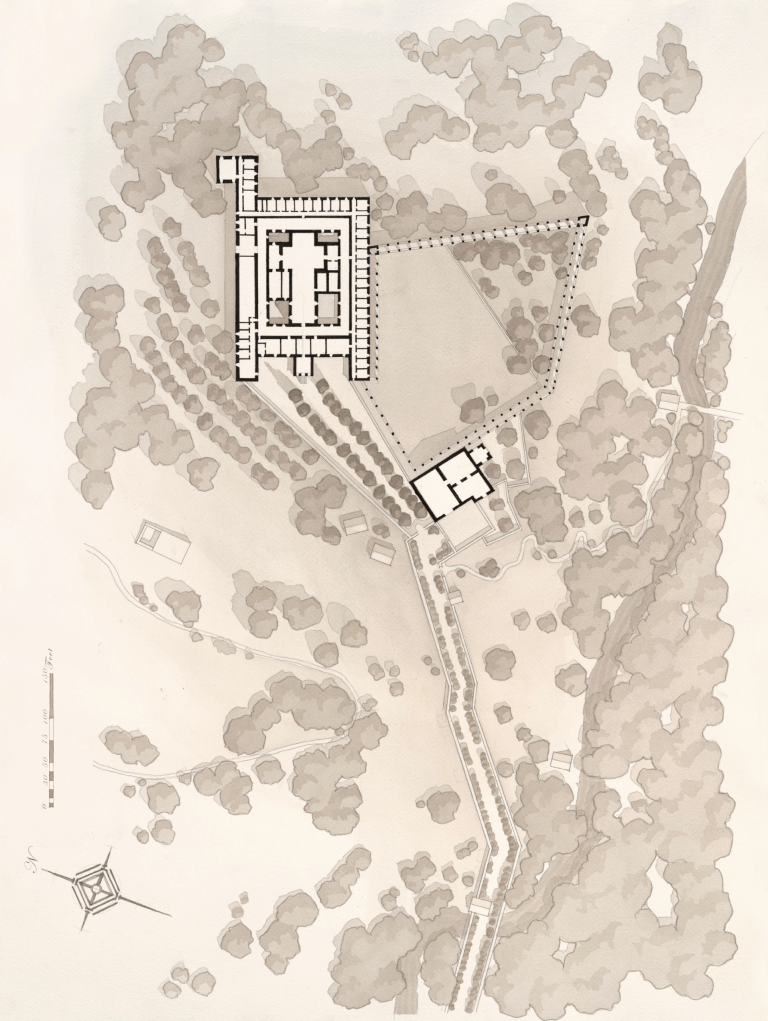
Original Monastery Plan
This wash rendering shows the plan of the original convent from 1697. Similar to its successor, it follows the Iberian model, wherein the chapel occupies the middle of the cloister. In this instance, little more than light wells remain of the cloister open space.A processional path leads from the main entrance of the monastery in the west, dotted with way shrines and grottos dedicated toOur Lord’s passion, Our Lady’s sorrows, and other sacred subjects.
The architecture of Las Palmas, like many of the Deserts, is an adaptation of the local character and materials to the ascetic, but not unaesthetic, ways of Carmelite life. Masonry walls with plaster finish, terra cotta tile roofs, and mural architecture elaborated by arches and vaults are the norm, as they were in much of the southern Mediterranean for many hundreds of years.
One of the defining features of Las Palmas was the multitude of devotional way shrines, grottos, and oratories that both dotted the landscape and created a processional pathway to the original monastery. In this way, while filled with the silent devotion of contemplatives, the Desert had a public aspect to its religious practices.
Complementing this was the flowering of art, both in terms of poetry and visual art, that filled these oratories and shrines. It has been the great pleasure of the authors of the present volume to translate this poetry into English. The poetry is characterized by a terse, passionate, and familiar style, usually taking up subjects frequently pondered by the hermits, such as Christ’s passion, the devotion of the saints, or the way of the Desert as set forth by Elijah and St.John the Baptist.
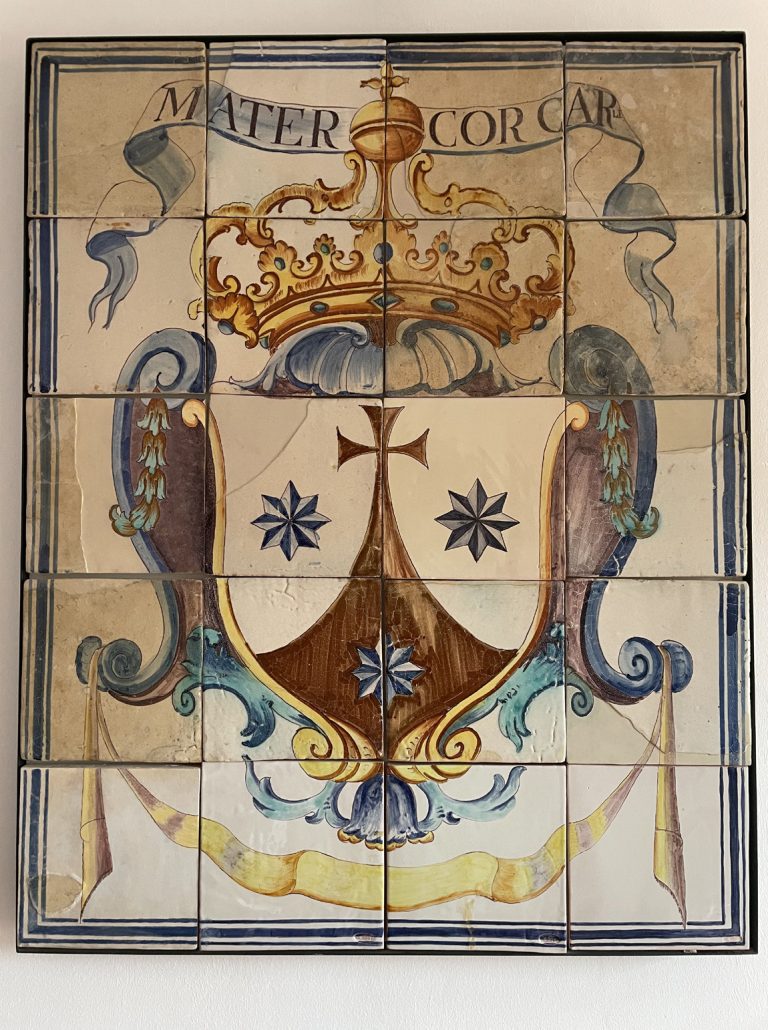
In the visual arts, beautifully painted tiles of rich polychrome filled the shrines, in a style akin to this depiction of the Carmelite crest.
Painted Decoration at Hermitage Chapel Ceiling
Photo Gallery
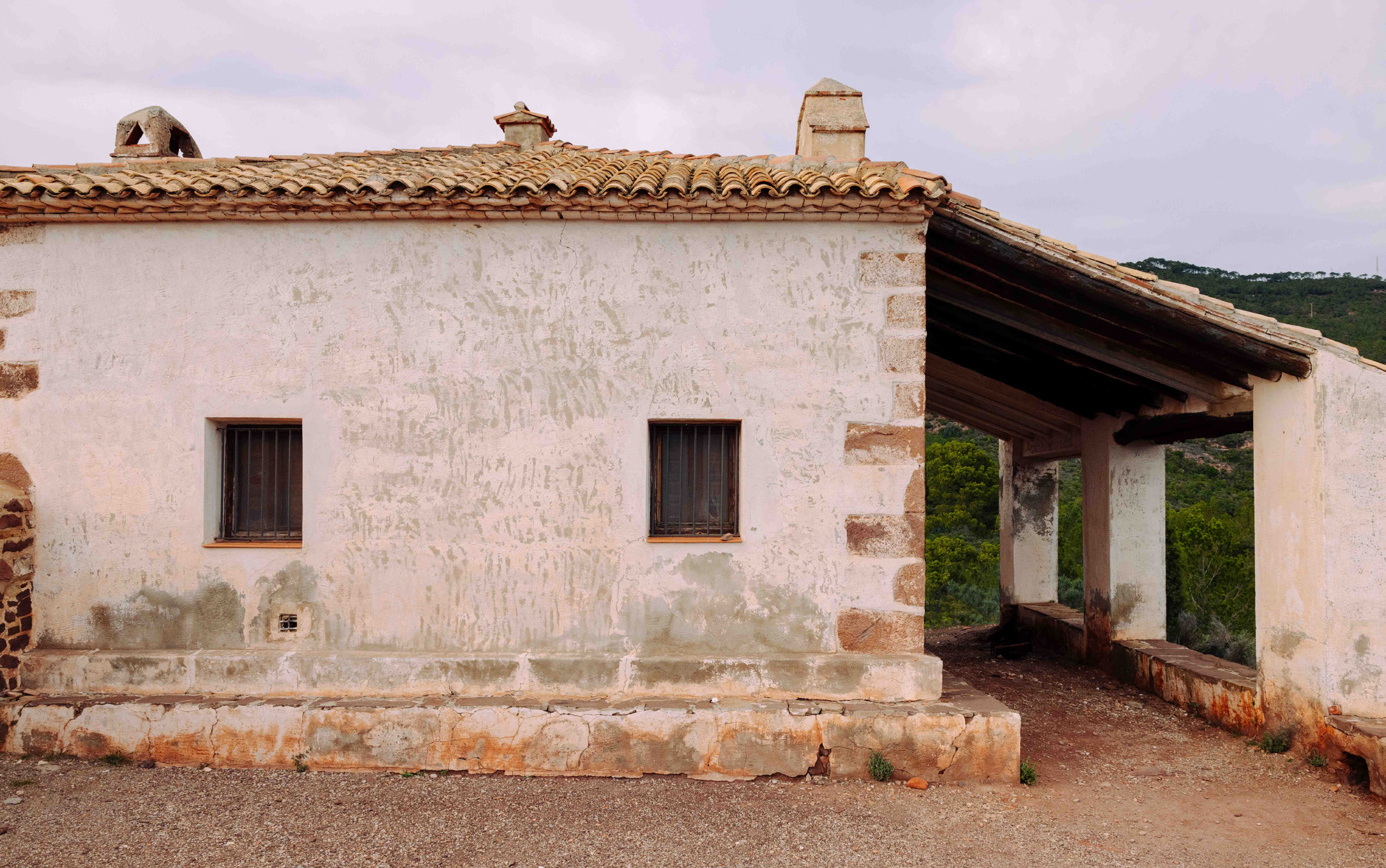
This oratory, connected to the Porteria Alta by a crenellated wall, is dedicated to Our Lady of Carmen. Oratories such as these were sometimes incorporated into the exterior wall of the Deserts as a gift of mercy to the lay faithful who would come to the Carmelite Fathers seeking spiritual renewal. Mass could be celebrated within the Desert, and communion distributed through a window.
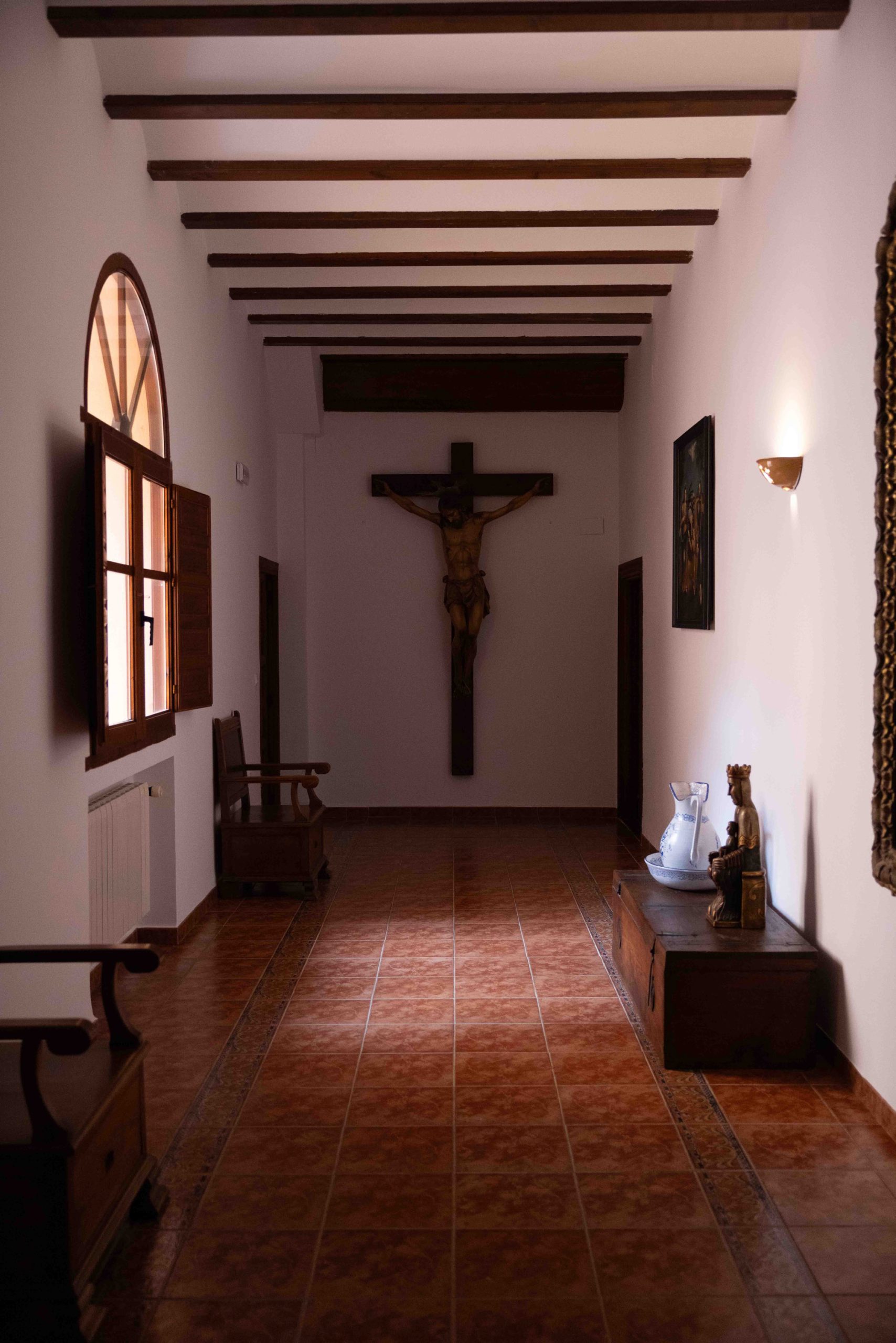
The first floor corridors have higher ceilings and a more vertical proportion, treated as a piano nobile with more decorous finishes and ancient artifacts as well as antique paintings. However, the theme of simplicity and durability remains; glazed tile for the floor, white plaster walls, and structural articulation at the ceiling are consistent throughout.
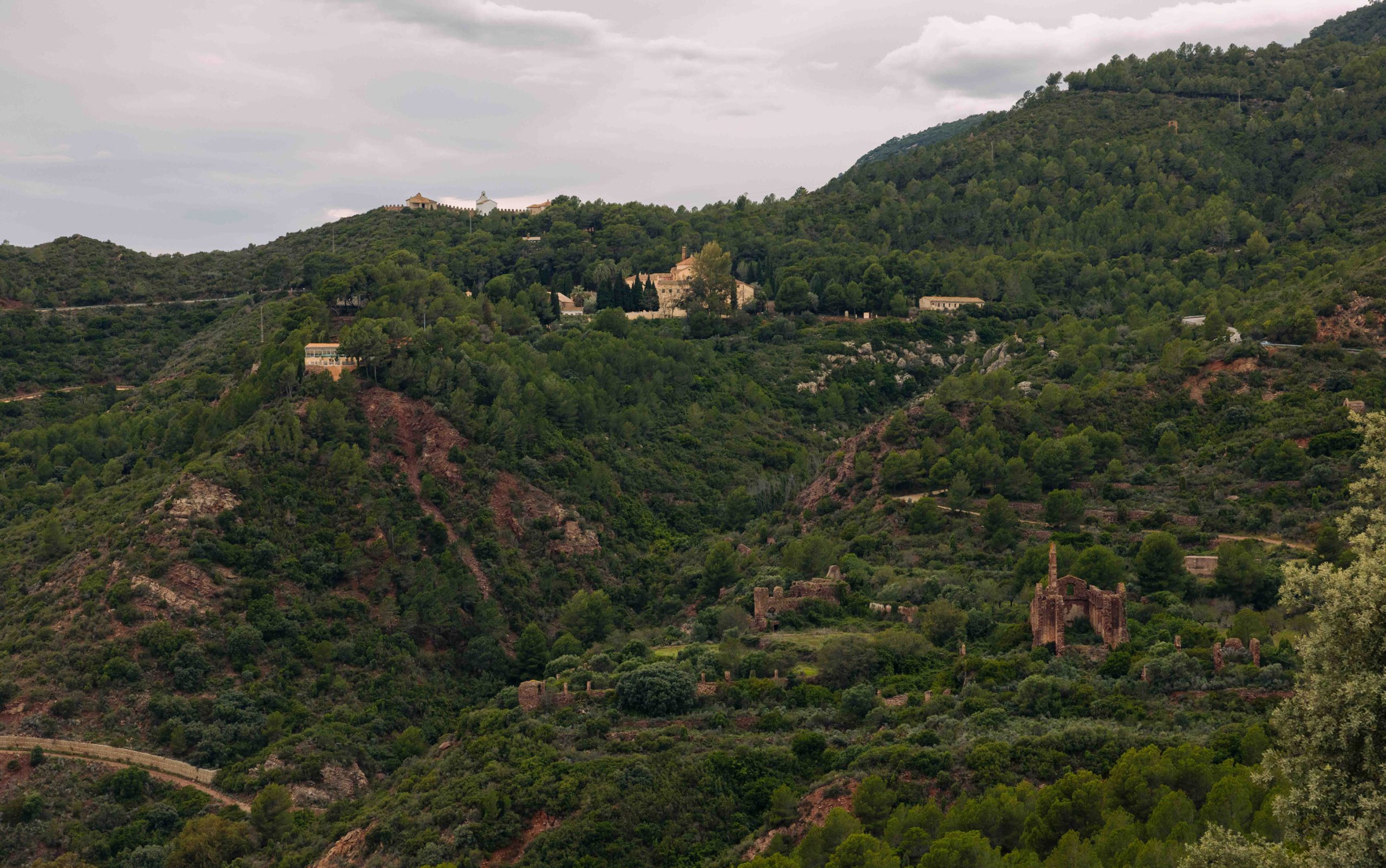
In this view from the St. Teresa of Jesus Hermitage, the original monastery can be seen at the bottom right. Abandoned in 1783, the monastic building has mostly fallen away; only the shell of the chapel stands, lacking facade and roof. Immediately to the left, a large open cloister and work buildings are barely visible through vegetation. Above at center, the new monastery rises just above the horizon line, while the Porteria Alta is poised on a crest at top left. A sharp eye may discern the St. Dismas oratory at far right.
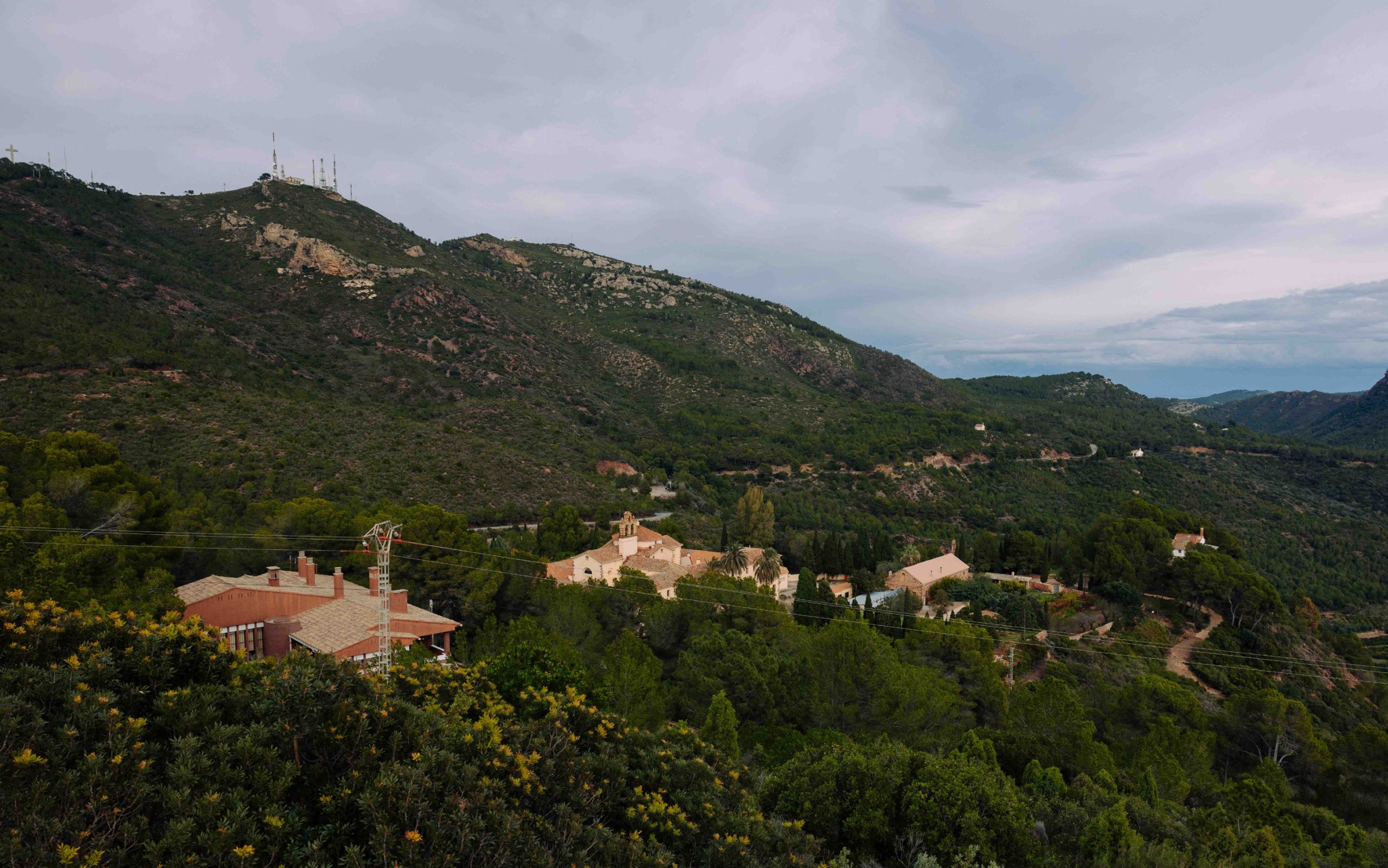
This view from the Porteria Alta takes in a wide swath of the rocky but verdant Desert of Las Palmas. At the top left, a high cross has been erected, and the St. Michael hermitage is visible on the Bartolo Mountain’s peak, though it is rather unfortunately overshadowed by a number of signal towers. In the middle of the image is the new monastery, designed in 1791 by a lay brother of the order. In the distance are visible the St. Teresa, St. Spyridon, St. Euthymius, and Our Lady of Montserrat hermitages.
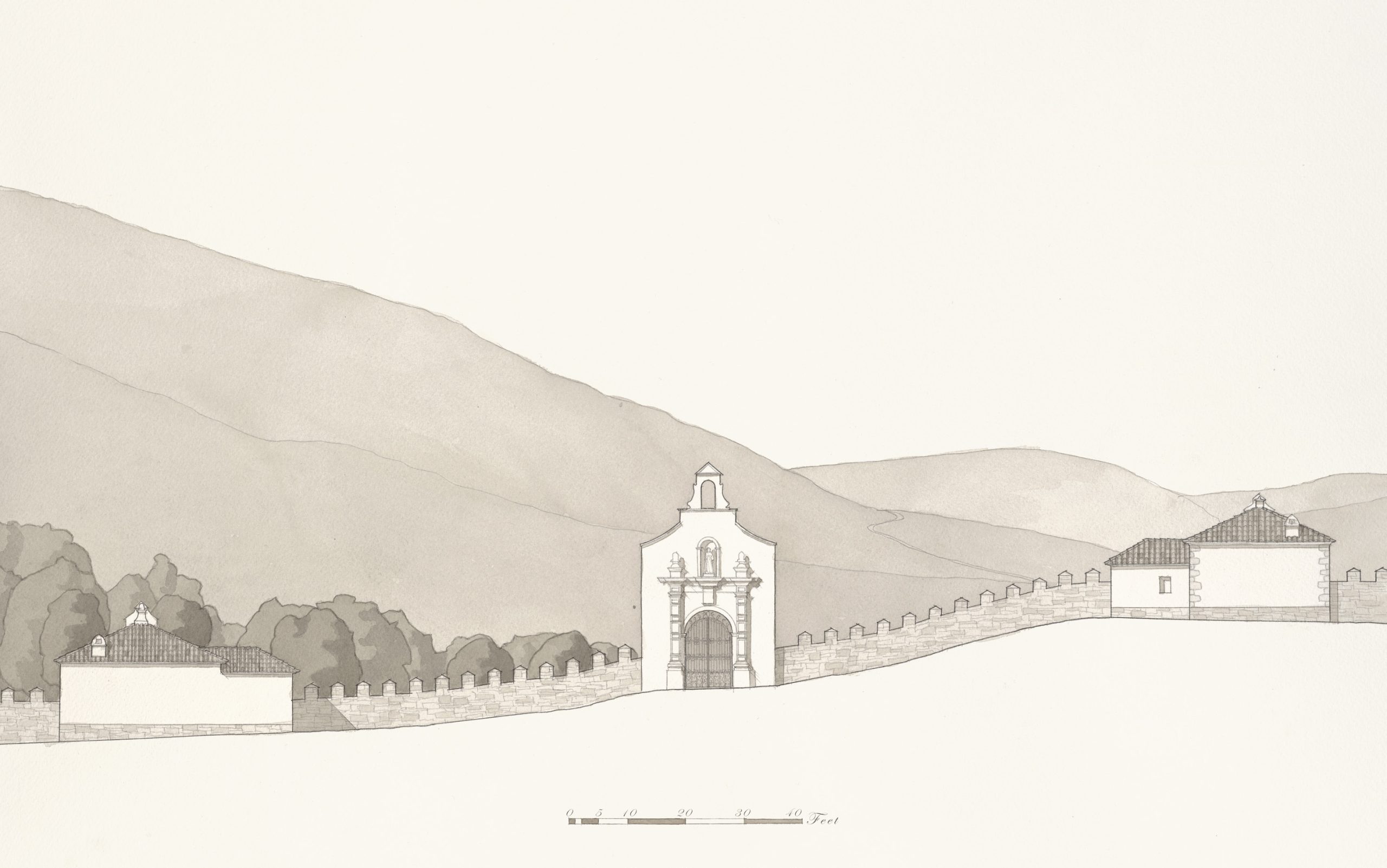
The Porteria Alta, or High Gate, served as the monastery’s main entrance, until a modern highway cut straight through the desert. The Porteria itself has been accurately reconstructed from historic renderings. On the right or North side is the St. John the Baptist oratory, and on the South or left side, the Our Lady of Carmen oratory. The central gatehouse also would have served as a chapel. Only very important donors such as the family who donated the land for the Desert, were permitted past the gate on special occasions.
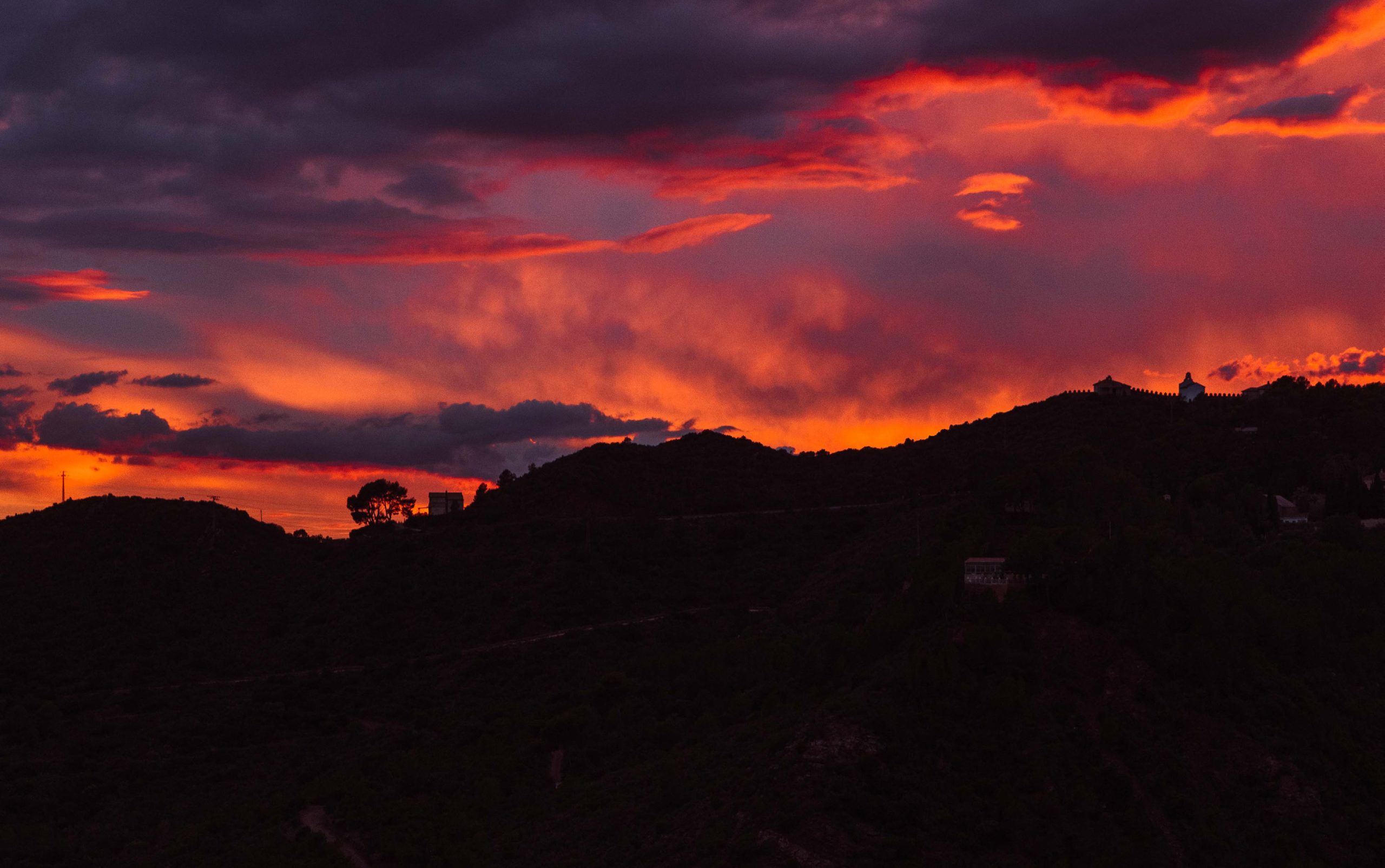
They sky is lit by the sunset as if the clouds themselves could catch fire, silhouetting the Porteria Alta in a cloak of amber and violet hues. For the contemplative hermit, the beauties of nature reveal like a mirror the Goodness and Mercy of God. In the Deserts, there are few words or people who could possibly distract from sublime contemplation, and perpetual sacrifice. The immolation of the hermit’s soul in the sacrificial life of eremitical practice is like unto these clouds; intense and beautiful, rare, only possible by God’s Grace.
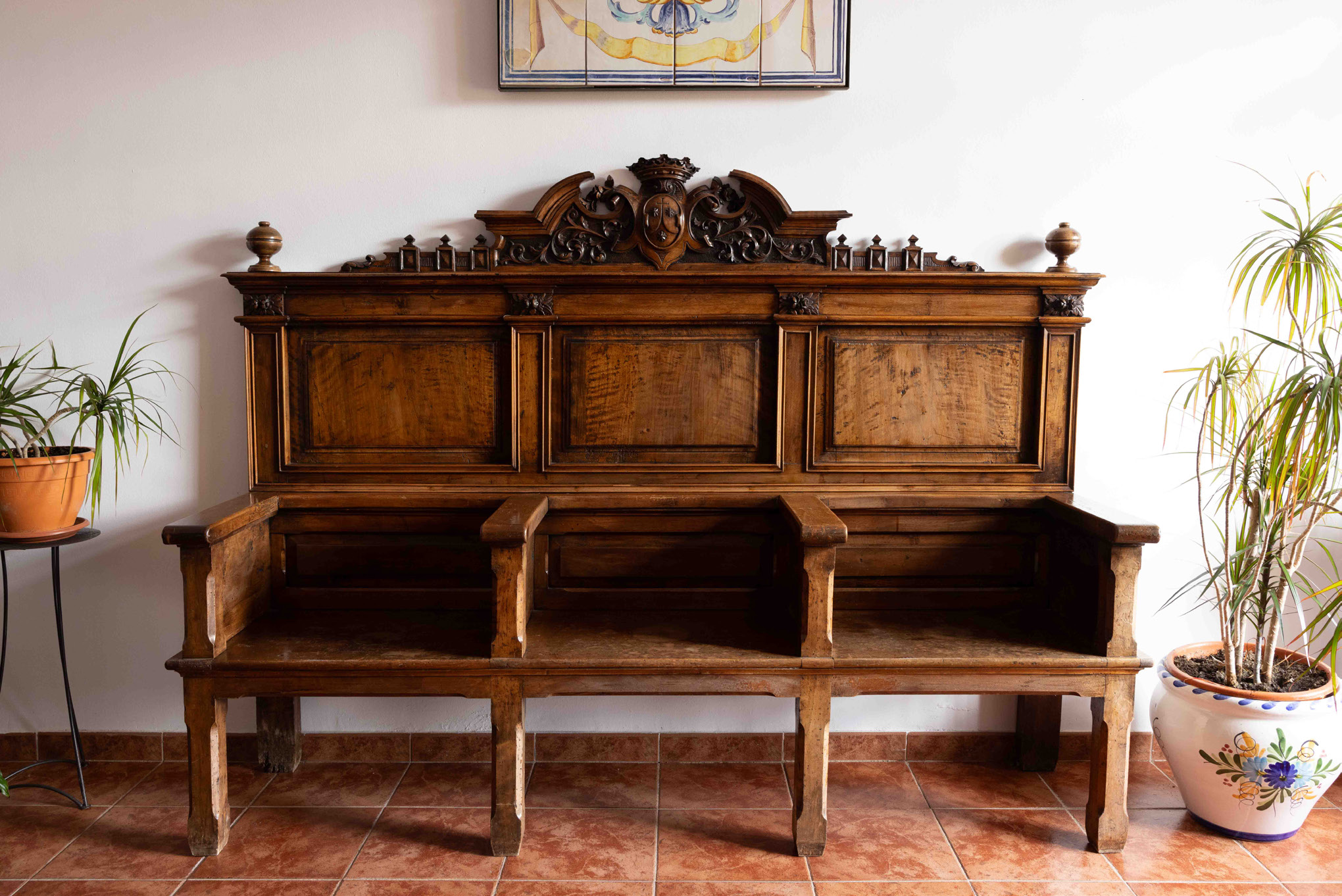
In the South Entry Vestibule, leading to the gardens and mausoleum, a stained wood bench showcases the delicate balance of Carmelite aesthetic. Beautifully carved at its highest and finest points, totally pragmatic in its panelized construction and rustic legs, and crowned by the Carmelite crest, which points ever upward in a sign on interior ascension.
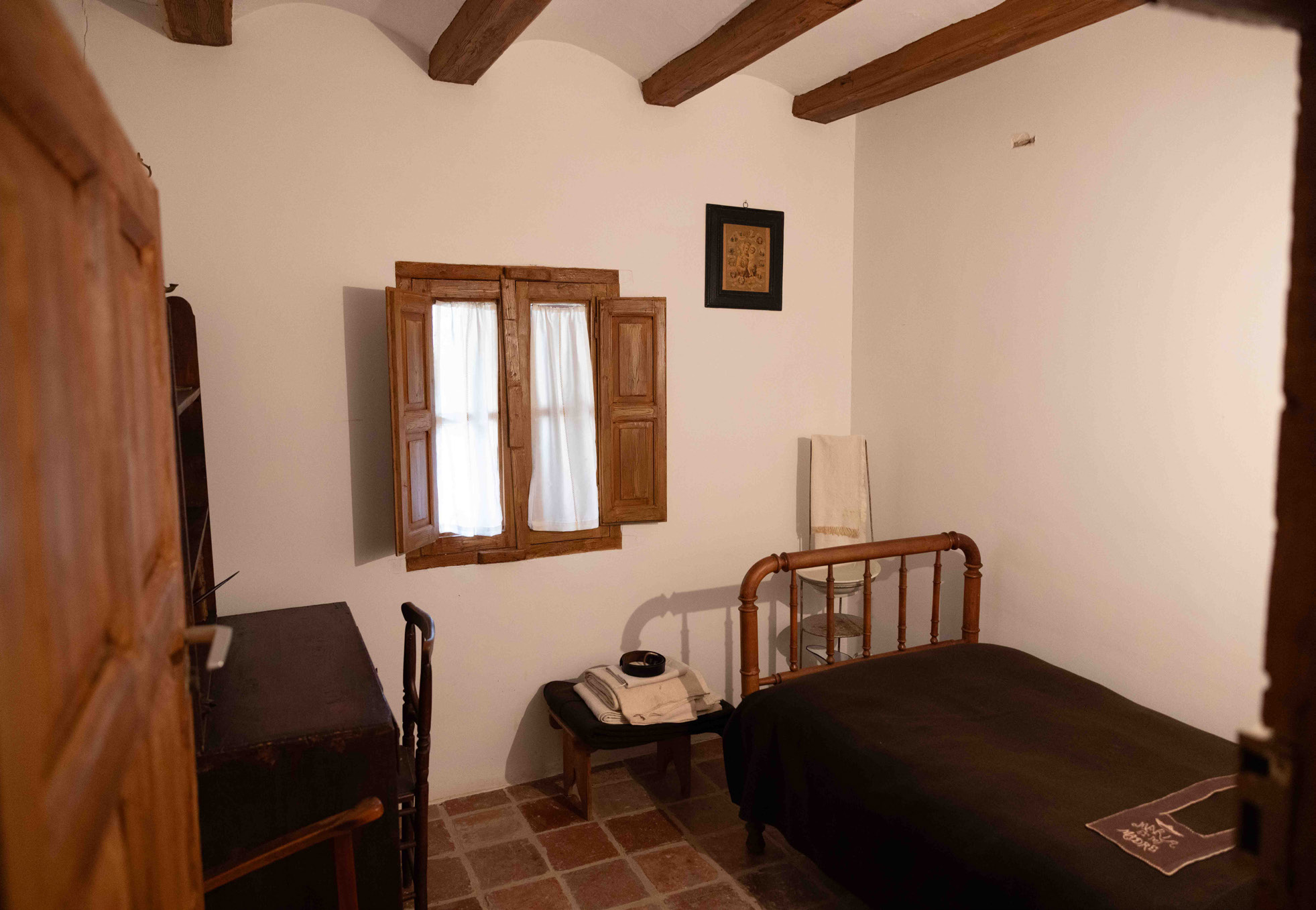
The cells in the new monastery at Las Palmas are of various sizes, of which this one is the smallest. The harmonious proportion of a square (equal width and depth) lend the room a sense of rest. Wood beams decorate the bottom of shallow vaults, and the floor tile complements the humble stain color of the wood door and window.
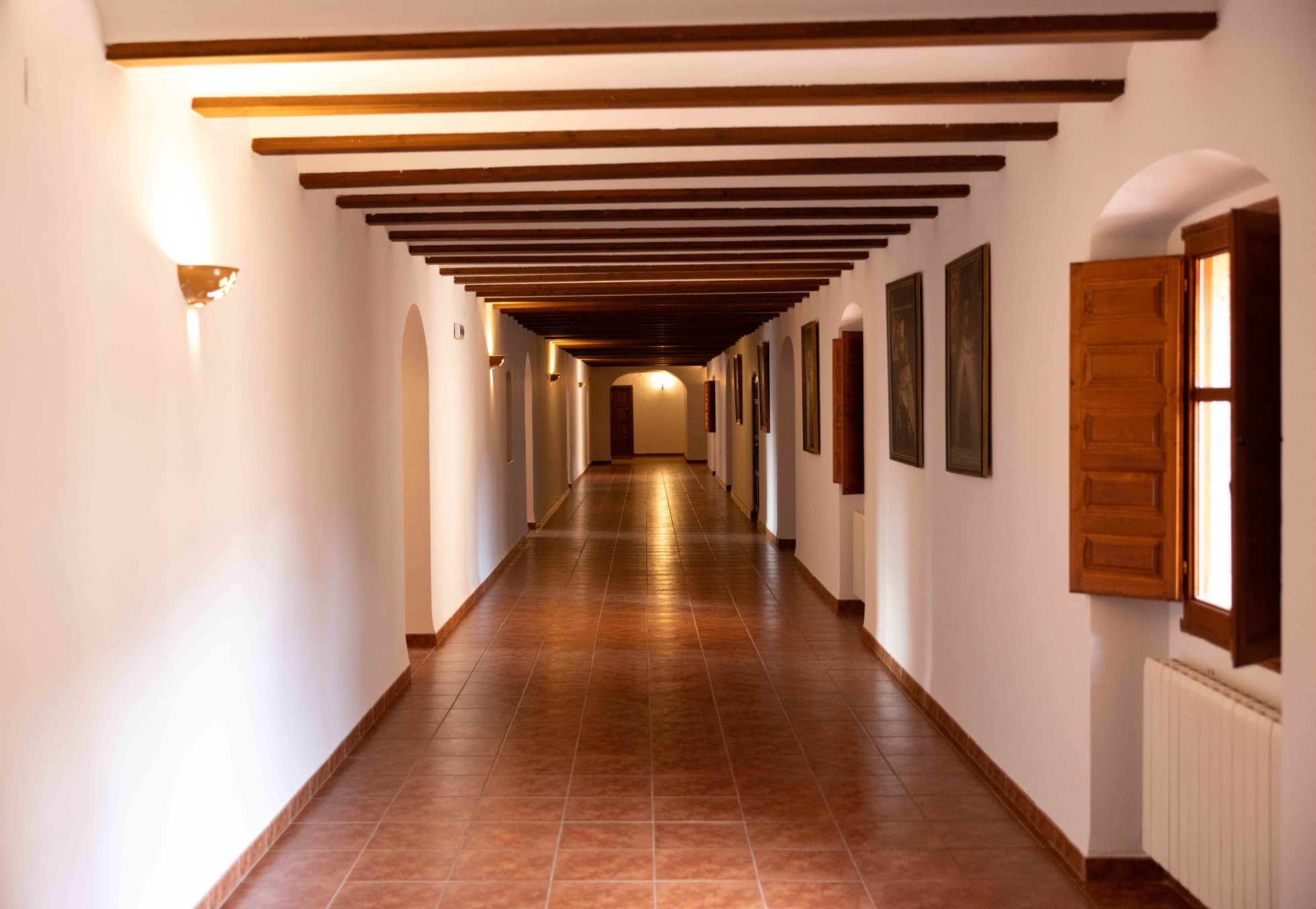
The typical upper level corridor is wider than at many other Deserts, at nine feet wide, though humble in vertical proportion less than a square. Unarticulated arched openings at windows and doors create calm sightlines, with only the ceiling beams running crosswise to contribute a sense of distance to the hundred foot long hallway.
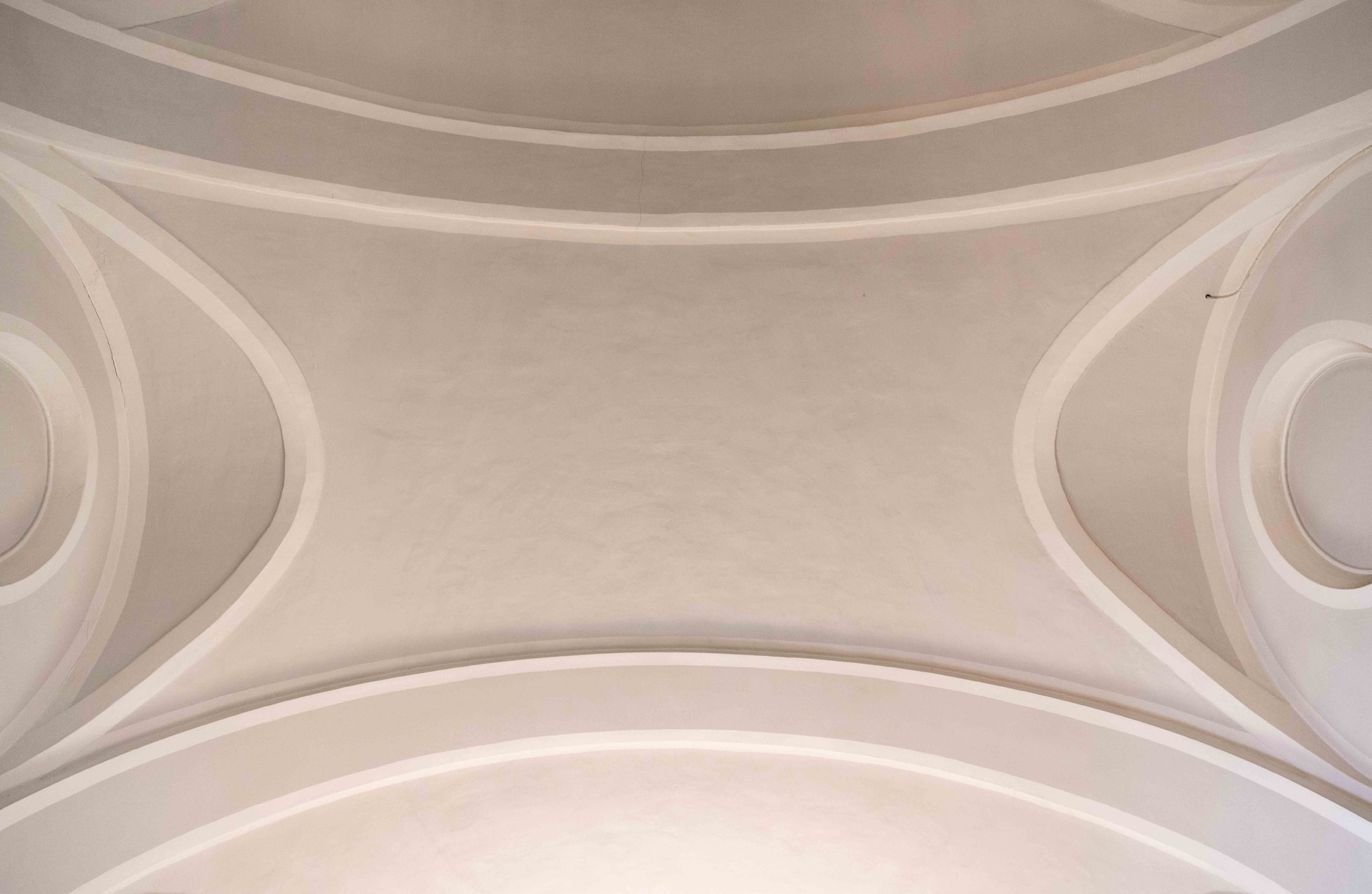
The chapel is designed in a greek cross, having four transepts or arms of equal length. A dome surmounts the center, and each transept rises into a simply but beautifully ribbed barrel vault with lunette arches on either side. These geometries are ideal for acoustics and light diffusion in addition to being beautiful and structurally efficient.
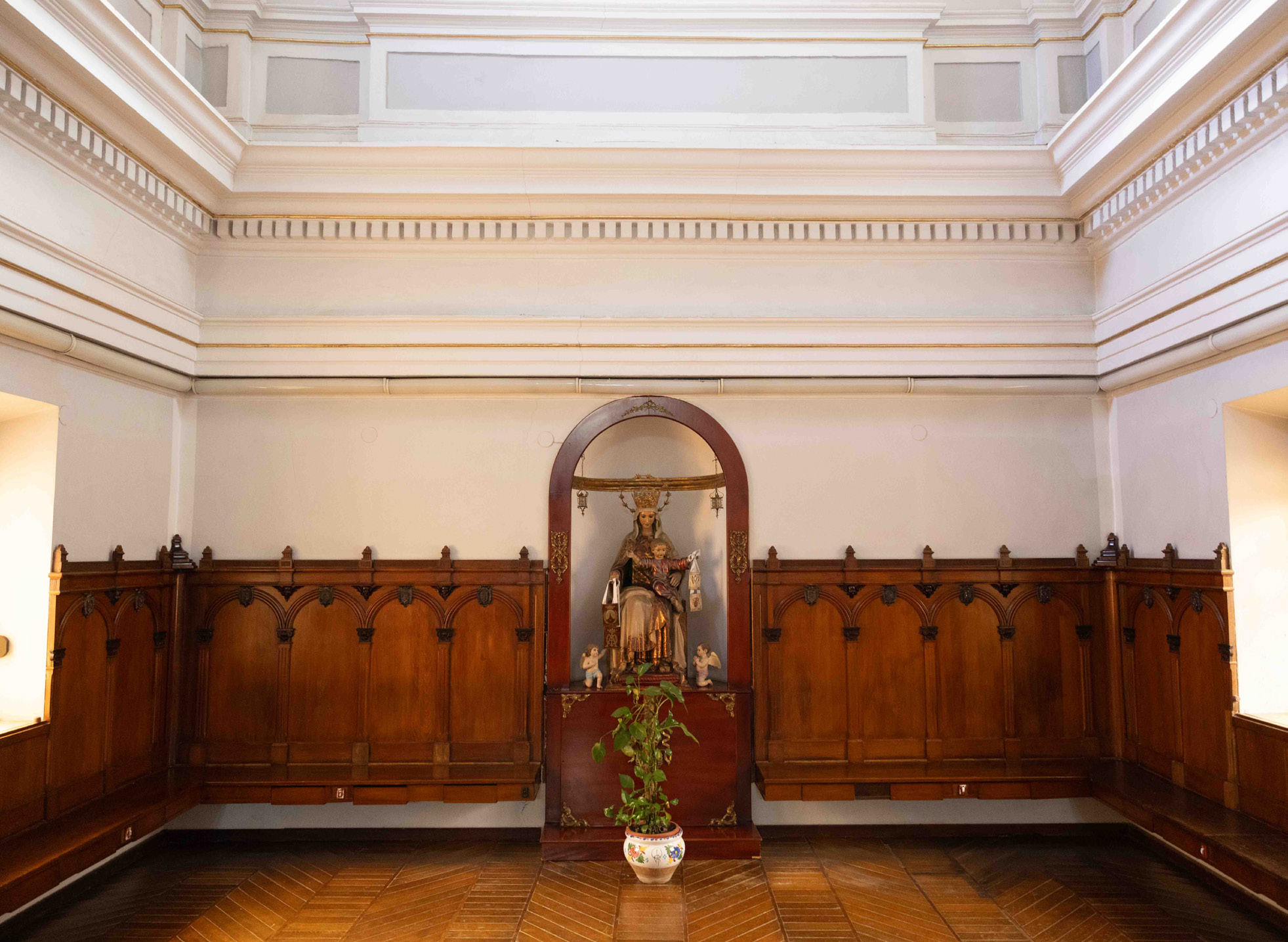
The monastic choir is situated above the sacristy, opposite the high altar. The earthy tones of the stained wood choir offsets the etheral white of the chapel architecture in color as well as scale; the contrast mirrors the dichotomy between mankind, made of clay, and the pure and perfect eternal realities of Heaven, which Christ’s sacrifice opens to us.
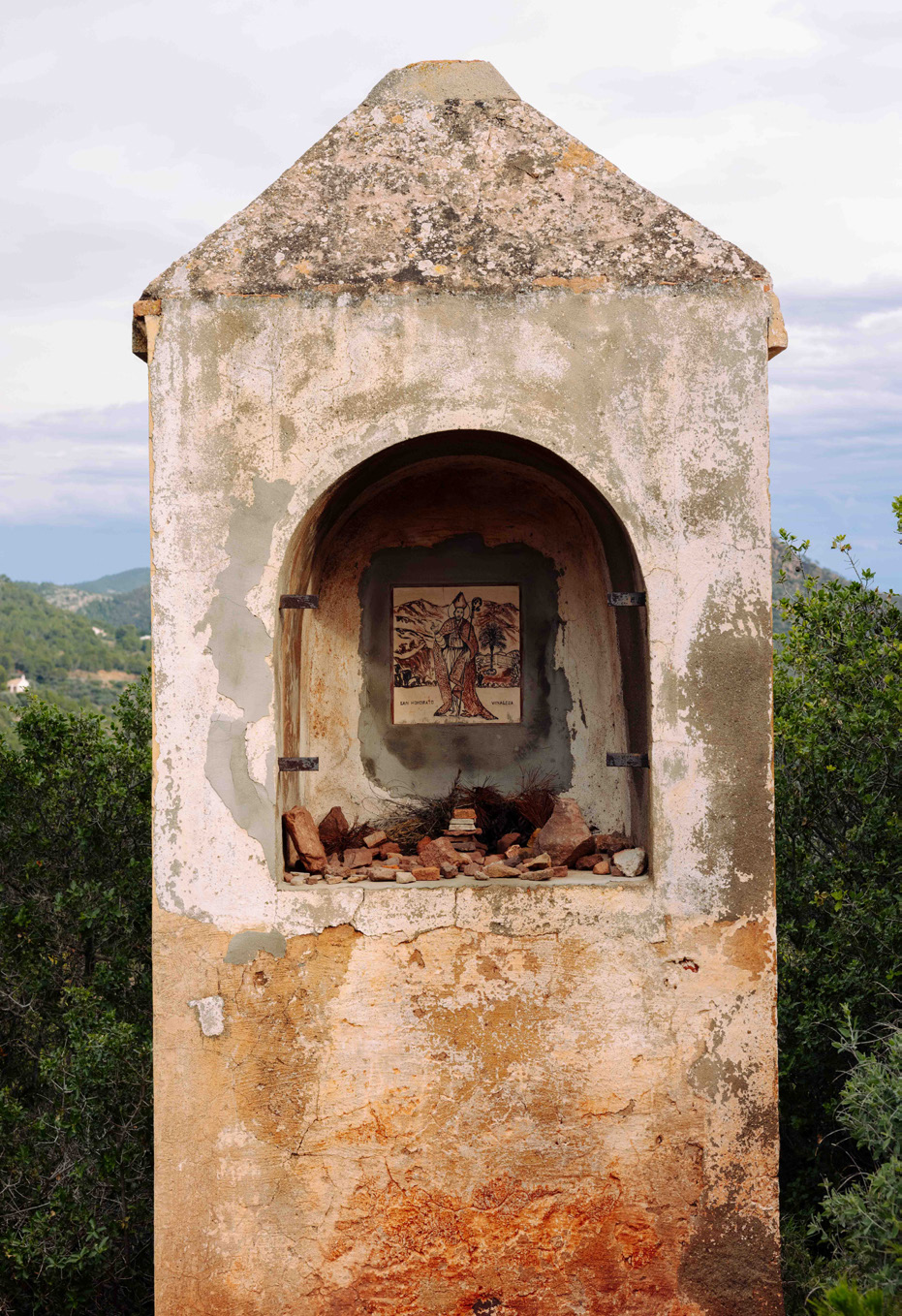
A painted tile dedicated to St. Honorius, missionary to the Anglo-Saxons and fifth Archbishop of Canterbury takes shelter in a wayshrine just behind the Porteria Alta.
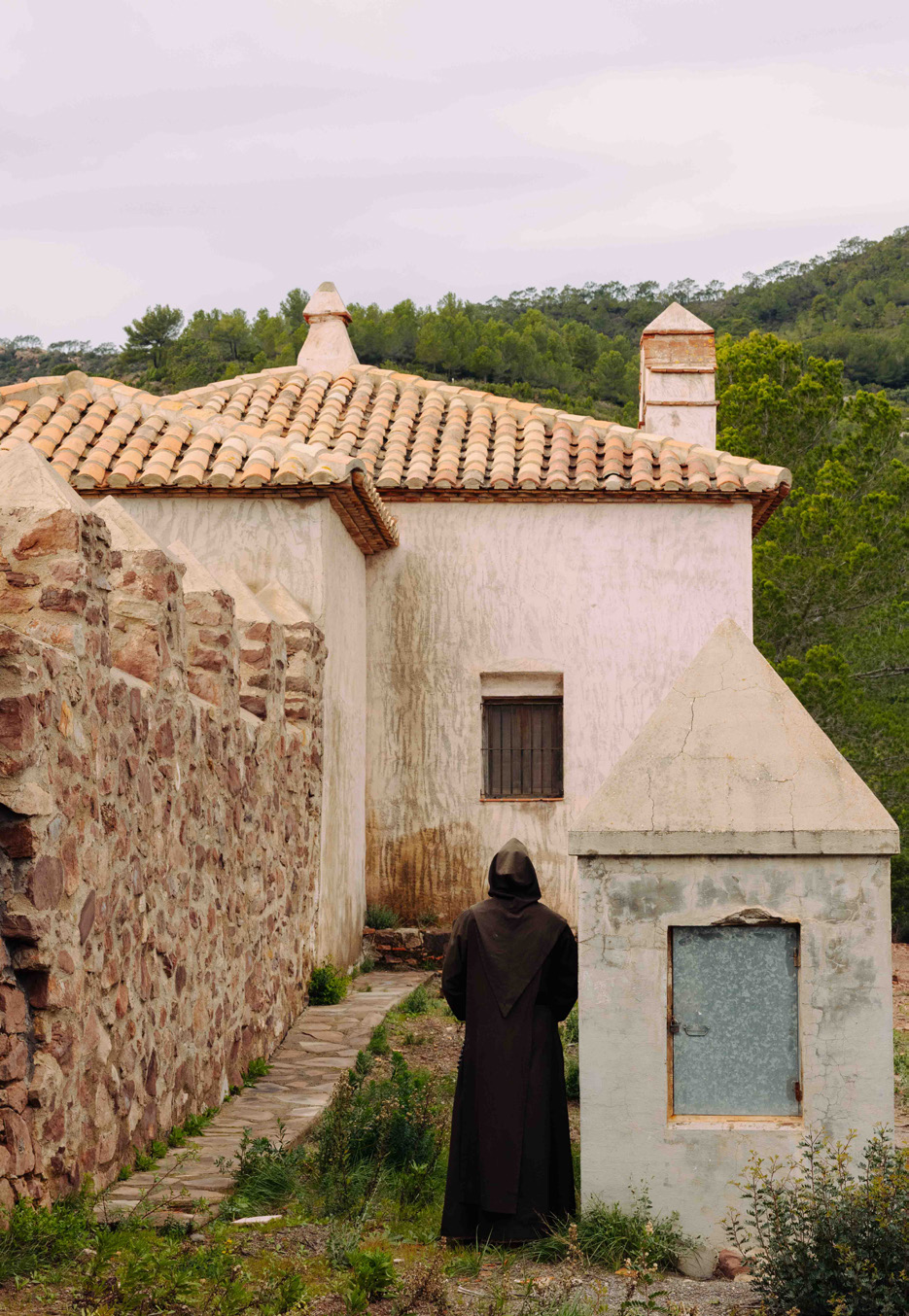
A hermit stands behind the Porteria Alta wall, considering the simple nobility of the St. John the Baptist Oratory.
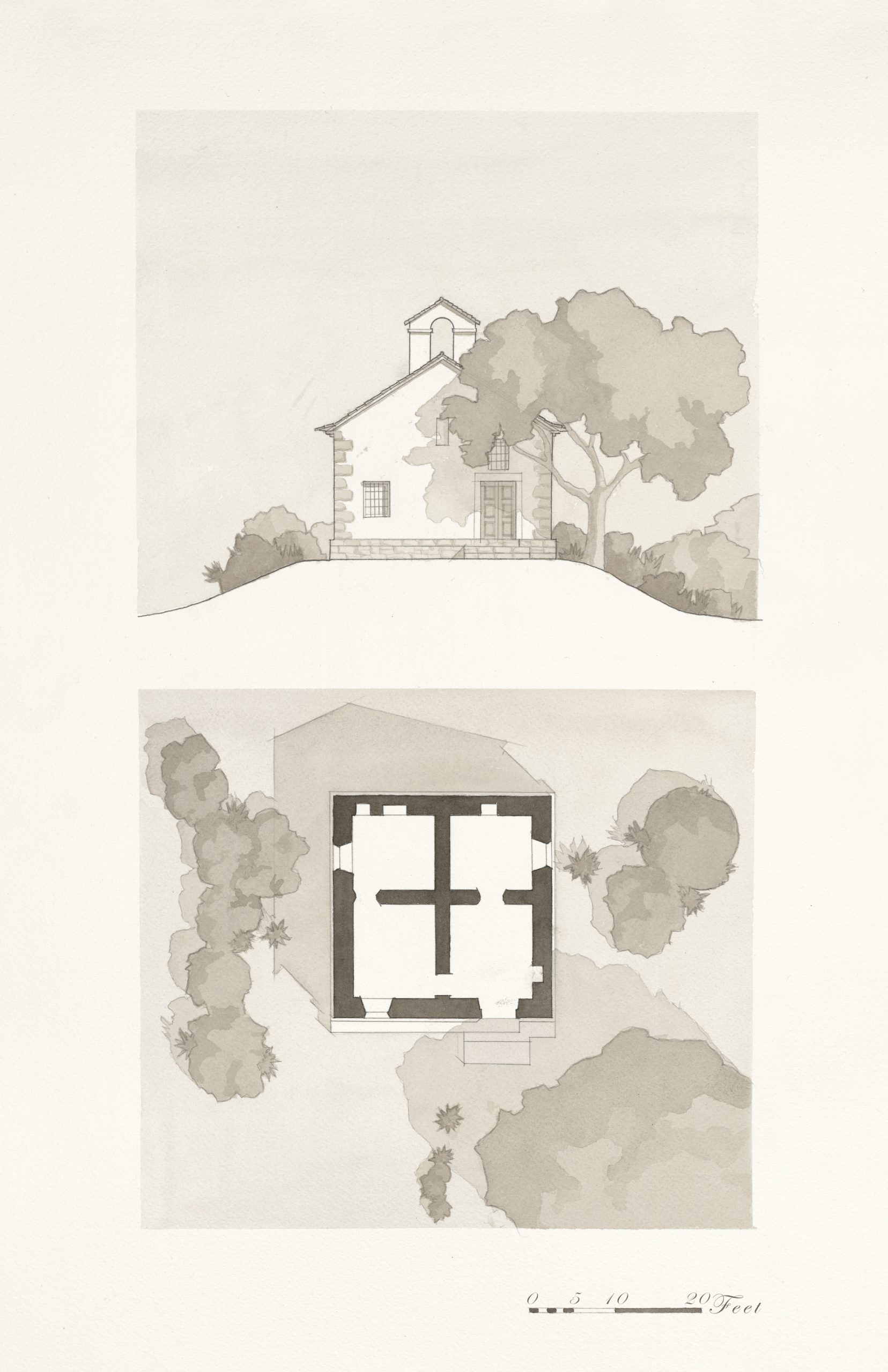
Many of the hermitages at Las Palmas follow a similar quadratic scheme in plan. One quarter was for chapel, one for sleeping, one for cooking and eating, and one for work. Architecturally, the robust stone quoining joins the terracotta details at the roof line to emphasize the simple but beautiful form of the edifice, punctuated by a center belcote.
Historic Poetry
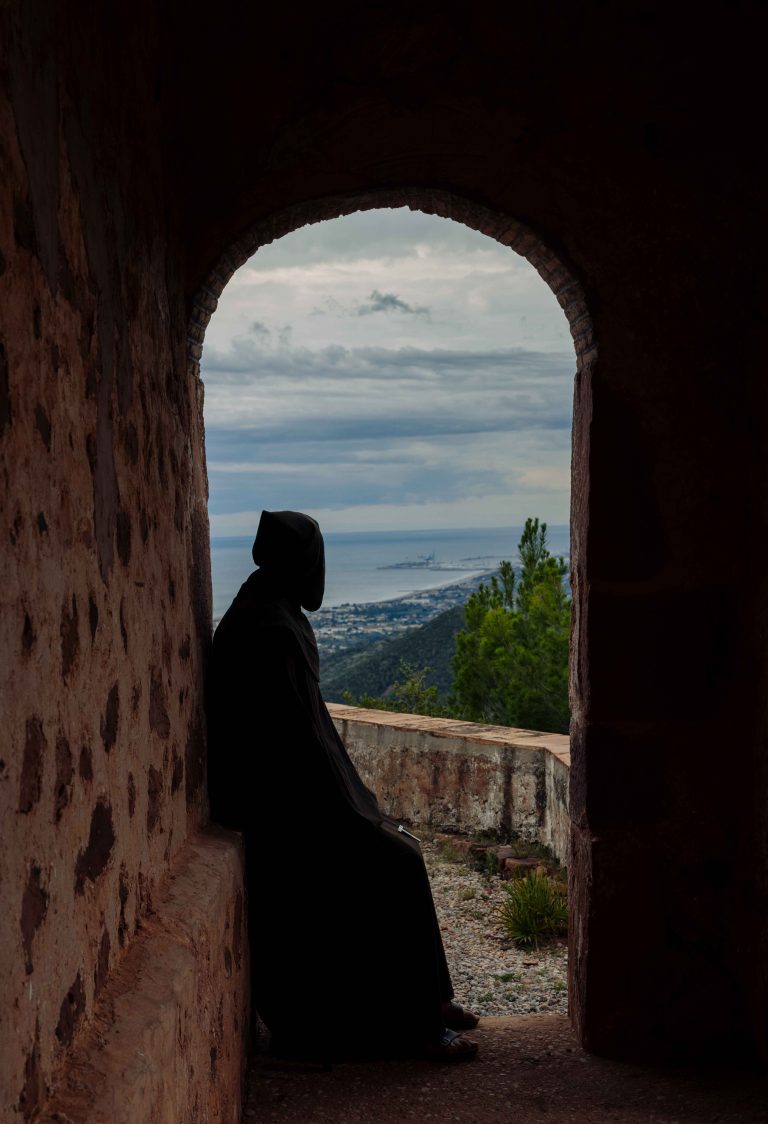
St Teresa of Jesus Hermitage Arcade
A monk sits quietly at the end of the hermitage arcade. While the coastline of nearby Benicassim has been extensively developed since the original settlement of the Desert, the view is much the same from that of three hundred years ago. Eliminating the distraction of close contact, seeing the smallness of human society reminds the hermit of the vanity of worldly pursuits.
“En una profunda cueva
Esta mujer valerosa
Se encierra triste y llorosa,
Penitente hija de Eva.
Aqui su dolor remueva
Del ya sometido mal
Y á su cuerpo desleal,
Castigo ofreció tambien;
Pues por el mal dejó el bien
Cuando pecó en bien y en mal.
Aqui la fuerza de amor
Hace que contra si sea,
La que por su mal fue rea
Por su bien acusador.
Que como mira el amor,
La injuria del ofendido,
Ya sumamente querído,
El dolor abraza y quiere;
Porque solamente muere,
Por morir á lo que ha sido.
Contra si misma se enoja,
Y aborrece sus cabellos,
Joyas, perlas lazos bellos,
Todo por el suelo arroja.
Entre dolor y congoja,
Aunque el natural resista,
Llora y gime su conquista
Con tan confusos enojos,
Que en el llanto de sus ojos
Sale ahogándose su vida.
Cuantos de mis desvarios
Dice, estaban ya juzgados,
Si acaso estan condenados,
Los muertos amigos mios.
Llorad, llorad, ojos míos
De amor y de confusión;
Pues tales mis culpas son,
Que por las mias allá
Mi amigo al infierno vá,
Y á mi me ofrecen perdón.”
In a deep cave
This valiant woman
Encloses herself, sad and tearful,
Penitent daughter of Eve.
Here her sorrow is stirred
By the evil already chastised
And to her disloyal body,
Also offered punishment;
Since for evil she left the good
When she sinned in good and evil.
Here the strength of love
Pits her against herself,
She for her own evil convicted,
Accuser, for her own good.
For the way that love sees
The injury of the offended one,
Already deeply loved,
It loves and embraces pain;
For she only dies,
By dying to what she had been.
She is angry with herself,
And she abhors her hair,
Jewels, pearls, fair ribbons,
Throws everything to the ground.
Between sorrow and anguish,
Although her nature resists,
She cries and moans over her conquest
With such conflicting anger,
That in the tears of her eyes,
Her life is drowning.
How many of my follies
She says, were already judged,
If perhaps my friends,
Are condemned, among the dead.
Cry, cry, oh eyes of mine
For love and confusion;
For such are my sins,
That over there, because of them,
My friend goes off to hell,
And to me is offered forgiveness.
St. Mary Magdalene Grotto - Mural Poetry, Anonymous; Translation by authors
The poetry written by contemplative Carmelites in their years of solitude and prayer has been permanently incorporated into the various grottoes and oratories spread throughout the Desert of Las Palmas. Many of the works take up subjects from the Gospels such as Christ’s passion, but many also use the titular saint as a frame of reference for spiritual meditation, such as this poem.

Photographed and Documented by
The Discalced Hermits of Our Lady of Mount Carmel
A Roman Catholic religious community.